
Up with Rainbow Dildos, Down with War
An Anti-Imperialist Analysis of Neoliberal Humor

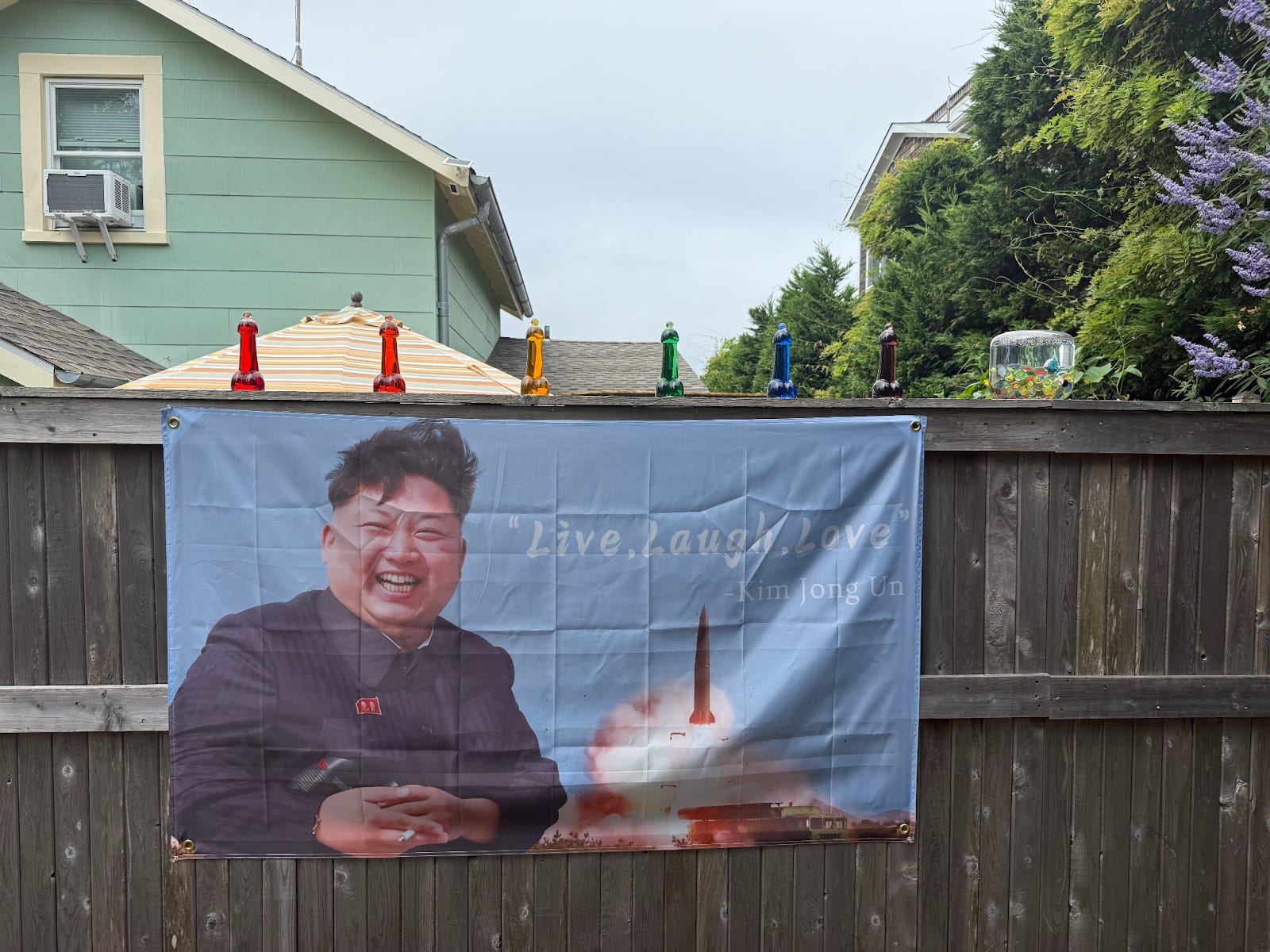
As the U.S. ramps up its drive to dominate the globe, it feels important to revisit a conversation I had with a dear friend after seeing this bizarre display on a queer beach in Fire Island last summer. What began as a text thread about the satirical potential of dildos and the dangers of this particular brand of “whimsy” became a deeper exploration of imperialism and resistance.
TL;DR: This cocky display enables empire by making light of the devastating toll of America’s longest-running war.
Fire Island has always been a flawed fantasy, an imperfect paradise. It was jarring, though not surprising, to walk past this banner in the middle of my queer happy place. My time in this semi-oasis is precious, yet I often wrestle with disappointment, disgust, or betrayal—seeing American flags all over town, hearing about homeowners taking down Black Lives Matter signs, enduring straight bachelorette party invasions from the mainland, and always confronting the entrenched class and race barriers that exclude so many queer people who could benefit most from–and enrich–this safer space.
This time, instead of just dissociating and keeping it moving, I reached out to my co-madre, J.K., a Korean American human rights and environmental advocate, writer, and cultural worker who explores transgenerational healing in the context of historical violence. Together we unpacked how Western imperialist propaganda seeps into every inch of our society, often disguised as irony or humor. [Note: She is using her initials out of an abundance of caution due to the unpredictable, triangulated political tensions between the Democratic People’s Republic of Korea, the United States, and the Republic of Korea—as well as shadowy transnational groups that don’t want the Korean War to ever end]
There is a difference between vacuous mockery and critique that carefully considers the historical conditions that have shaped North Korea. This poster + rainbow dildo configuration falls squarely in the former category and does nothing to deepen our understanding of a country that has closed itself off from the West for the sake of its very survival.
The following piece is an edited version of a long conversation that unfolded between us.
ORA: I saw this display during my annual foray to Fire Island. It was disconcerting. Something didn’t sit right with me. What do you think about this???
JW: I have an analysis but it must be prefaced by my strong and obvious denunciation of authoritarianism—communist or capitalist.
OW: Even your obligatory condemnation is a maddening indication of how binary Western political discourse is and how hypocritical the U.S. is.
JW: The West has been quite successful at discrediting the DPRK (Democratic People’s Republic of Korea) as a rational political actor by ridiculing the Kim political dynasty—something I learned from veteran Korea peace organizers. This decontextualizes the militant resilience and juche (self-sufficiency) politic that has sustained the DPRK for more than seven decades. So much so that its citizens enjoy some rights that most Americans can only dream of, like universal healthcare and guaranteed paid maternity leave.
The sheer determination that made this happen cannot be underestimated. Like Cuba, the DPRK has endured draconian, multi-sector sanctions, orchestrated and enforced by the U.S., that hurt civilians the most — blocking access to basic medical equipment, pharmaceuticals, and even agricultural equipment that would greatly alleviate famine and malnutrition. Like Iran, the DPRK’s nuclear program is quite possibly the key factor in preventing its complete annihilation — a difficult contradiction to hold for those of us who want universal nuclear disarmament. Posters like the one above, IMO, trivialize the longstanding defiance of U.S. imperialism by one of a tiny handful of countries as a fluke led by buffoons.
OW: I see a parallel to the demonization of Hamas, a narrative strategy that denies Israel’s domination and destruction of the Palestinian people. They are characterized as violent religious extremists without any complexity or understanding. There is no mention of the horrific conditions under which their non-military wing struggles to provide basic civil services, nor of Israel’s deliberate decades-long campaign to crush any secular, leftist Palestinian organizations.
JW: Absolutely. Western caricatures of the DPRK accomplish a similar kind of flattening that both mocks and demonizes a tiny country that the United States has punished ruthlessly for not losing the war. Seventy-five years after the U.S. proxy war that killed 4 million of my people in 3 years, the continued absence of a formal peace agreement between the U.S. and the DPRK is big business — but no laughing matter.
OW: Understanding this, the obfuscation of this meme is actually violent.
JW: I mean, the Kim Il Sung political dynasty is indisputably authoritarian. But one might argue that they have been forced to be, as a teeny country (with no coveted natural resources) that did not submit to the most powerful empire of our era. Like Cuba, its very existence poses an existential threat to U.S. hegemony!
Also, there is a racialized component to this satire that is annoying—the docile, naïve Asians following an eccentric cultish dictator. The whole vibe is giving Long Duc Dong from the eighties film 16 Candles (which may be a Gen X cultural reference that our comrades might not get).
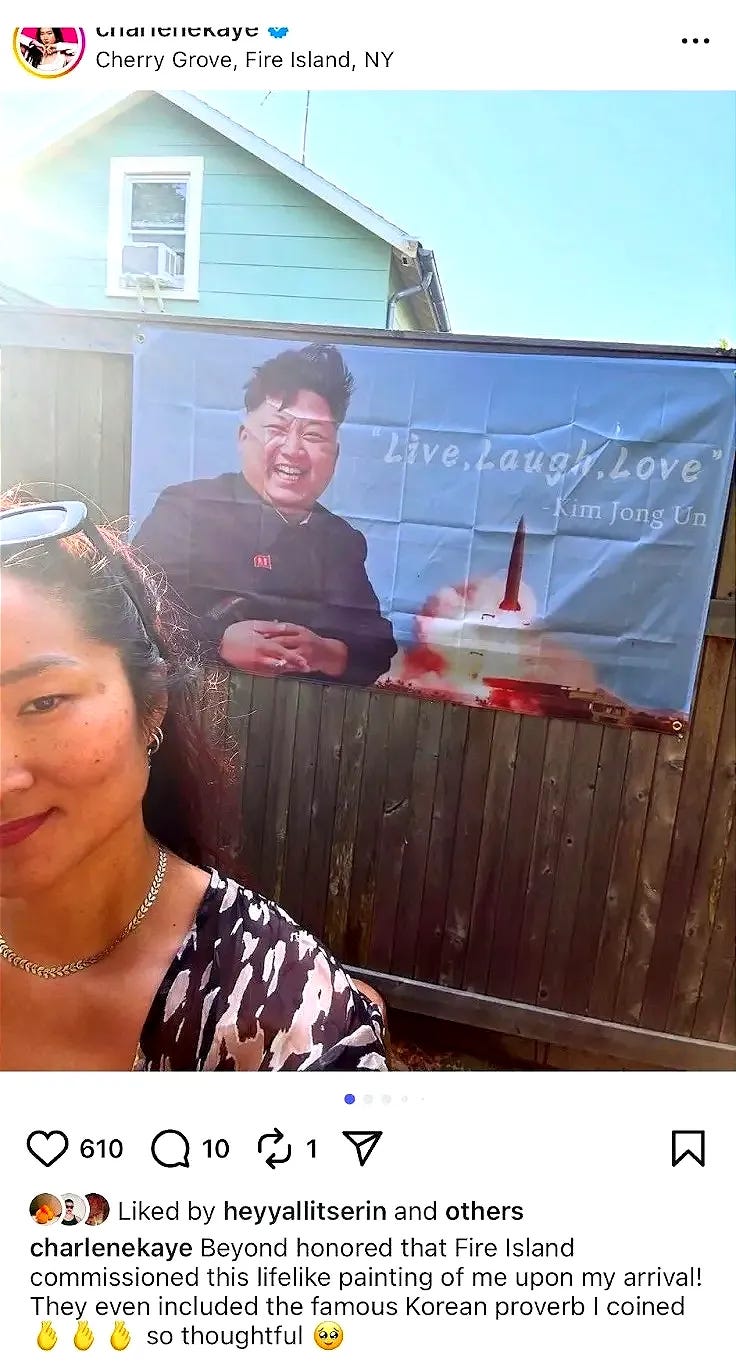
OW: Absolutely it’s an extension of that caricature. Not to mention ironic given the nature of the current US regime and its supporters.
If the people who hung this poster up are attempting to critique the DPRK for being ruthlessly authoritarian, they are doing so while erasing the ruthlessness of the U.S. war in Korea. Which proves that they do not actually care about the people there.
JW: Exactly. U.S. forces killed 20% of the population of northern Korea in an aerial bombing campaign that historians now describe as a genocide. And they did so as they withdrew. North Korea is the most hardcore expression of anti-imperialist resistance born of trauma. A Han politic, if you will. (Han /한 is a Korean word for the embodied experience of accumulated grief and rage resulting from historical violence.) After the “temporary” armistice that halted but did not end the war, the response of the North Korean state was to channel the people’s Han into a rigorous practice of juche.
OW: This description of Han reminds me of how Zionism has weaponized generational trauma. It emerged as a Jewish response to centuries of violence and oppression that was based on aligning with Empire. It ultimately overpowered and sought to erase other movements and visions for Jewish survival that were predicated on solidarity and resistance to fascism—such as The Jewish Labour Bund or Arab Jewish revolutionary socialists involved in anti-colonial struggles in Africa such as Abraham Serfaty.
Korean juche is a reaction to han that emphasizes internal rigor while Zionism is an externalized reaction to han, one that manifests as imperialist domination of others. Including the “other within”– Arab and African Jews, the concept of the “weak” Diaspora Jew, Yiddish, even).
JW: Internal rigor is how the DPRK has held the line for 75 years. It’s hardcore. As someone whose maternal line comes from the north, I can’t help but feel pride in their resilience.
So in short, I approve of the rainbow dildos but I don’t like the poster!
Live, laugh, love — but don’t be an ugly American.
Absolutely brilliant breakdown of how political satire can actually obscure real trauma. The Han concept adds so much depth here—I've seen similar weaponization of historical grief in other contexts, where humor becomes a way to avoid engaging with the messy reality of survial under empire. Makes me think diferently about what we laugh at and why.